
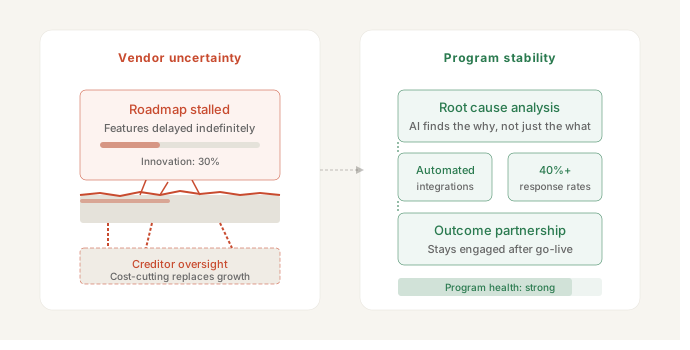
Stability is the foundation of any customer experience program. When that foundation shakes, the cracks show up in your data first. Right now, Medallia customers are facing a choice they did not ask for. With reports suggesting the company may be turned over to its banking creditors, the future of the product is no longer just a matter of engineering. It is a matter of finance. This creates a specific type of risk for your team. Whether you are committed to your existing setup or considering a full replacement, you need a plan that protects your ability to find and fix customer friction.
"Your CX strategy shouldn't be held hostage by a vendor's debt obligations."
The Real Cost of Corporate Uncertainty
When a major player in the CX space faces a potential turnover to creditors, the primary casualty is usually innovation. Leadership teams focused on debt restructuring rarely prioritize the next generation of features. For you, this means the tools you use today might look exactly the same three years from now. In a world where customer expectations move weekly, that kind of stagnation is dangerous. We have seen what happens when CX teams are stuck with legacy tools while the rest of the market moves toward faster, more precise feedback loops. The risk is not just that the software breaks; it is that your program loses its edge because the vendor is distracted by their own balance sheet.
Finding the Signal in the Noise
We recently helped a leading UK retail bank that was dealing with a sudden, unexplained crisis. Their NPS had dropped sharply among their most valuable account holders & those in the Black and Silver tiers. The team could see the drop in their dashboard, but they could not see the cause. The data was there, but the answer was buried. Most teams we talk to find themselves in this exact position: you know something is wrong, but the tools you use are too rigid to tell you why. We used AI sentiment analysis and NLP on verbatim customer feedback to isolate the driver. We found the problem was not the bank's service or its rates. It was a new booking system in the web portal.
By looking at the actual words customers used, we identified the online channel as the primary cause of the friction. This was not a general feeling of dissatisfaction; it was a specific technical flaw that was hurting the bank's most profitable relationships. This is what we mean when we talk about getting more from your program. It is about moving past high-level scores and getting to the specific root causes that drive revenue or churn.
Dealing with a similar blind spot in your CX program?
Let's talkFrom Manual Surveys to 40% Response Rates
Efficiency is the other side of the coin. Many organizations are still bogged down by manual processes that should have been automated years ago. Consider the work we did with a national treasury and government finance agency. They were struggling with manual survey distribution that was slow, inconsistent, and yielded low engagement. Their team was spending more time managing the process than acting on the results. This is a common pain point for large enterprise teams who have outgrown their original setup but feel stuck with the complexity of their current vendor.
We implemented a system that integrated directly with their PBX and used SMS surveys to capture feedback in real-time. The results were immediate:
- Manual survey work was completely eliminated, freeing the team for high-level analysis.
- Response rates jumped to 40%, providing a much more accurate picture of performance.
- Data started flowing into the organisation fast enough to influence daily operations.
This level of automation is not a luxury. It is what allows a CX team to actually do their job instead of acting as data entry clerks for a legacy platform.
A national treasury agency went from negligible manual survey responses to 40% via automated SMS — triggered the moment each call ended. Manual work eliminated entirely.
Deciding Your Next Move
If you are currently on a Medallia program, you have two paths. The first is to look for a future on the existing program. This requires a partner who can help you extract more value and innovation than the vendor might be able to provide on its own. The second path is a full replacement. We have seen that switching does not have to be the nightmare many fear. It is an opportunity to fix the architecture of your program and remove the friction that has been slowing you down for years. We take care of our customers regardless of which path they choose.
Most teams we talk to are dealing with the same internal pressure to prove ROI while their tools are becoming more expensive and less flexible. Based on what we have seen with similar companies, the best way forward is to focus on outcomes and evidence. Stop looking at product features and start looking at how quickly you can identify a problem like the UK bank's booking system flaw.
Ready to future-proof your CX program?
Whether you want to extend your existing program or replace it entirely, trustMinder can help you move forward with confidence.
Talk to trustMinder